Key Components of a Modern De Mineralization System Explained
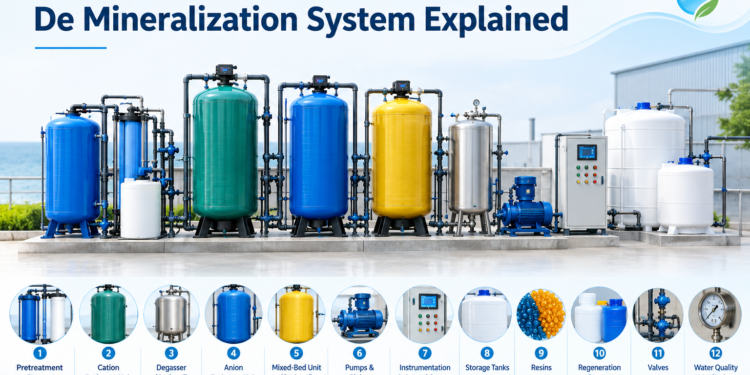
Industries that require low-mineral or high-purity water depend on properly designed treatment systems to remove dissolved ions from their water supply. A De Mineralization System uses a combination of treatment components to reduce minerals such as calcium, magnesium, sodium, chloride, sulphate, and other dissolved ions. Each component has a specific role, and their proper selection can directly influence water quality, operating efficiency, and system reliability.
Modern DM systems can be designed in different configurations depending on feed-water quality, required capacity, desired water purity, and the industrial application. Understanding the major components makes it easier to evaluate how the complete system works.
What Is a De Mineralization System?
A De Mineralization System, commonly known as a DM plant, is designed to remove dissolved ionic impurities from water. Conventional systems primarily use ion-exchange technology.
In an ion-exchange process, dissolved positively and negatively charged ions are exchanged with hydrogen and hydroxide ions. These ions combine to form water, resulting in water with significantly reduced mineral content.
A typical system may follow this arrangement:
Pretreatment → Cation Exchanger → Anion Exchanger → Mixed-Bed Unit → Demineralized Water
Not every application requires all these stages. The final configuration depends on the quality of the incoming water and the required treated-water specifications.
1. Pretreatment System
Pretreatment is the first important component of a DM plant. Its purpose is to protect downstream equipment and ion-exchange resins from contaminants that can reduce their performance.
Depending on the raw-water quality, pretreatment may include:
- Raw-water filtration
- Multimedia filtration
- Activated carbon filtration
- Water softening
- Cartridge filtration
- Chemical dosing
The exact pretreatment arrangement should be selected based on a detailed analysis of the feed water.
2. Cation Exchange Unit
The cation exchanger is one of the main components of a conventional demineralization system.
Water passes through a vessel containing cation-exchange resin. The resin removes positively charged ions such as calcium, magnesium, sodium, and other cations.
These ions are exchanged with hydrogen ions from the resin. The treated water then moves toward the anion-exchange stage.
The performance of the cation unit depends on factors such as resin condition, flow rate, feed-water chemistry, and regeneration practices.
3. Anion Exchange Unit
After passing through the cation exchanger, the water enters the anion exchanger.
This unit removes negatively charged ions such as chloride, sulphate, bicarbonate, nitrate, and other anions.
The anion resin exchanges these unwanted ions with hydroxide ions. The hydrogen and hydroxide ions introduced through the ion-exchange process combine to form water.
Together, the cation and anion units are responsible for removing most of the dissolved ionic content.
4. Degasser
Some DM system configurations include a degasser between the cation and anion stages.
The cation exchanger can convert bicarbonates into carbonic acid, which may subsequently release carbon dioxide. A degasser can help remove this carbon dioxide before the water enters the anion exchanger.
Reducing the carbon dioxide load can help improve anion resin utilization in suitable system configurations.
Whether a degasser is required depends on the feed-water chemistry and overall plant design.
5. Mixed-Bed Ion Exchange Unit
When very high-quality demineralized water is required, a mixed-bed unit may be installed after the primary cation and anion exchange stages.
A mixed-bed vessel contains both cation and anion resins mixed together. This arrangement provides additional ion removal and can significantly reduce the conductivity of the treated water.
Mixed-bed units are commonly considered for applications where higher-purity water is required, such as certain power-generation, pharmaceutical, laboratory, and specialized industrial processes.
6. Resin
Ion-exchange resin is the working material inside cation and anion vessels.
Different resin types are selected according to the ions that need to be removed and the operating conditions of the plant.
Resin performance can gradually decline as its exchange capacity is consumed. Regeneration restores the resin’s ability to exchange ions.
The correct resin selection, operating conditions, regeneration procedure, and maintenance practices are therefore important for maintaining consistent water quality.
7. Regeneration System
Ion-exchange resins require periodic regeneration after their available exchange capacity has been consumed.
Depending on the type of resin, regeneration generally involves appropriate chemical solutions. Cation resins and anion resins have different regeneration requirements.
A regeneration system can include:
- Chemical storage tanks
- Dosing arrangements
- Regeneration pumps
- Valves and piping
- Rinse-water arrangements
- Waste collection systems
Efficient regeneration is important because chemical consumption and wastewater generation contribute to the operating cost of a DM plant.
8. Pumps and Piping
Pumps are required to transfer water between different stages of the treatment system and maintain the required flow.
Piping connects the treatment vessels, pumps, storage tanks, valves, and other equipment. Proper sizing and material selection are important for reliable operation.
The system should also provide suitable access for inspection, maintenance, and replacement of components.
9. Valves
Valves control the movement of water and chemicals throughout the DM plant.
A conventional system may require different operating modes, including:
- Service
- Backwashing
- Regeneration
- Slow rinsing
- Fast rinsing
Manual or automated valves can be used depending on the plant design and desired level of automation.
10. Instrumentation and Control System
Modern DM plants can include instruments for monitoring important operating parameters.
Common monitoring points include:
- Conductivity
- Flow
- Pressure
- Water levels
- pH
- Chemical dosing
A control panel or automated control system can coordinate different treatment and regeneration steps. Automation can reduce manual intervention and help operators identify changes in system performance.
11. Storage Tanks
Storage tanks may be provided for raw water, treated water, regeneration chemicals, or intermediate water streams.
A treated-water storage tank allows the plant to maintain a supply of demineralized water even when the DM units are undergoing regeneration or maintenance.
Tank size should be determined according to water demand, production capacity, operating schedule, and system configuration.
12. Water Quality Monitoring
Continuous or periodic monitoring of treated-water quality is essential for a DM plant.
Conductivity is commonly monitored because it provides an indication of the ionic content remaining in the treated water. Depending on the application, additional parameters may also be monitored.
Regular monitoring helps operators identify resin exhaustion, process changes, or equipment problems before they significantly affect downstream operations.
How These Components Work Together
The performance of a De Mineralization System depends on the interaction between all its components.
A simplified sequence is:
Raw Water → Pretreatment → Cation Exchange → Degassing (if required) → Anion Exchange → Mixed Bed (if required) → Quality Monitoring → Treated Water Storage
During normal operation, the system removes dissolved ions step by step. When the ion-exchange resins become exhausted, the appropriate vessels are taken through their regeneration cycles before returning to service.
Choosing the Right Components
The components required for a DM system depend on several factors, including:
- Raw-water analysis
- Required water purity
- Plant capacity
- Operating hours
- Feed-water temperature
- Chemical availability
- Available installation space
- Automation requirements
- Maintenance capabilities
- Future expansion plans
For this reason, a DM plant should be designed around the actual requirements of the application rather than using the same configuration for every project.
Conclusion
A modern De Mineralization System consists of several interconnected components, including pretreatment equipment, cation and anion exchange units, resins, regeneration systems, pumps, valves, instrumentation, storage tanks, and, where required, mixed-bed polishing units. Each component contributes to the system’s ability to produce consistent low-mineral water.
Selecting the right components and configuring them according to feed-water quality and application requirements can improve system performance and operational reliability. Waterman Engineers India provides industrial water treatment solutions designed according to specific water-quality, capacity, and process requirements.