VR Fire Safety Training: Building a Safer and More Prepared Workforce
VR Fire Safety Training: Building a Safer and More Prepared Workforce
Fire emergencies can develop within seconds, leaving little time for employees to think through what they have learned in a classroom or read in a safety manual. In such situations, knowing the correct procedure is important, but being able to act quickly and confidently is even more critical. This is where Best VR fire safety training is changing the way organizations prepare their workforce for emergencies.
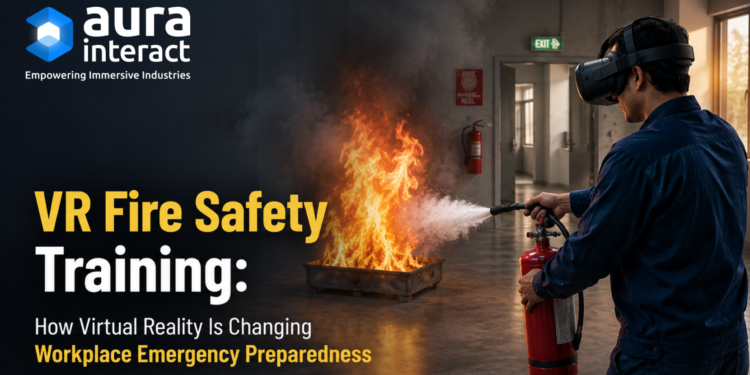
Virtual Reality (VR) creates realistic, interactive fire scenarios where employees can practise emergency procedures without being exposed to actual flames, smoke, equipment damage, or operational disruption. Instead of simply watching a demonstration, trainees can step into a simulated workplace, identify hazards, respond to alarms, choose appropriate actions, navigate evacuation routes, and practise using fire extinguishers.
According to Aura Interact, its Fire Safety VR module can transform a company’s standard operating procedures into immersive, repeatable simulations covering evacuation, extinguisher use, and hazard response.\ Research has also found that VR-based fire extinguisher training can improve knowledge acquisition and self-efficacy compared with conventional video-based training.
Why Traditional Fire Safety Training Is Not Always Enough
Traditional fire safety programs commonly rely on classroom presentations, printed manuals, instructional videos, demonstrations, and periodic fire drills. These methods remain valuable, but they often have limitations when the goal is to develop practical decision-making skills.
An employee may understand where the emergency exits are or recognize the different types of fire extinguishers during a classroom session. However, a real emergency can involve alarms, smoke, confusion, limited visibility, crowded corridors, and pressure to make rapid decisions.
VR addresses this gap by allowing employees to practise procedures rather than simply hear about them. They can experience simulated emergency situations and learn what actions to take, what mistakes to avoid, and when evacuation is safer than attempting to control a fire.
The learning process becomes more active, memorable, and practical because employees are required to interact with the environment and make decisions.
What Is VR Fire Safety Training?
VR fire safety training uses a virtual environment to simulate fire-related emergencies and workplace hazards. Wearing a VR headset, a trainee can enter a digital workplace such as an office, factory, warehouse, construction site, hotel, plant, or other industrial facility.
Within the simulation, the learner may encounter a fire, activate an alarm, identify an evacuation route, locate emergency equipment, select an appropriate extinguisher, or respond to changing conditions.
The environment can also be designed around an organization’s own safety procedures. Aura Interact describes its approach as using company SOPs and a photorealistic digital replica of the facility to create site-specific training scenarios.
This makes the training more relevant than a generic scenario because employees can become familiar with the layout, hazards, emergency procedures, and response expectations associated with their actual workplace.
Creating Realistic Fire Emergency Scenarios
One of the biggest advantages of VR is its ability to recreate situations that would be difficult, expensive, or dangerous to reproduce physically.
For example, a VR scenario can simulate a fire starting in a production area. The learner may hear an alarm, see smoke developing, identify nearby hazards, and determine the safest course of action. The situation can then require the employee to raise the alarm, alert others, follow an appropriate escape route, or use a fire extinguisher when it is safe and appropriate to do so.
Such simulations help employees understand that fire safety is not simply about knowing how to operate equipment. It is also about situational awareness, decision-making, communication, and evacuation discipline.
Research on immersive fire safety training highlights VR’s potential particularly where conventional live training would be dangerous or resource-intensive.
Practising Fire Extinguisher Use in a Safe Environment
Using a fire extinguisher correctly requires more than recognizing one in a storage cabinet. Employees need to understand which extinguisher is appropriate for a particular fire and how to operate it correctly.
VR allows trainees to practise this process repeatedly without using real extinguishing agents or creating an actual fire.
A common procedure taught in extinguisher training is the PASS technique: Pull, Aim, Squeeze, and Sweep. In a VR environment, learners can practise each stage using a virtual extinguisher and receive guidance when they make an error.
Aura Interact’s Fire Safety module specifically includes extinguisher types and fire classifications as well as hands-on practice of the PASS technique.
Repeated practice can help transform a procedure from something employees remember intellectually into something they can perform more naturally.
Learning How to Navigate Smoke and Evacuate Safely
Evacuation is another important part of fire emergency preparedness. During a real fire, visibility may be reduced and familiar surroundings can suddenly become difficult to navigate.
VR can simulate smoke-filled corridors, blocked routes, alarms, and other conditions that challenge an employee’s ability to respond calmly.
Learners can practise identifying safe exits, following emergency routes, staying low in low-visibility conditions, and moving toward designated assembly areas. Aura Interact’s module includes simulated smoke navigation and safe egress training based on the organization’s procedures.
This type of scenario-based practice can help employees become more familiar with emergency routes before an actual incident occurs.
Turning Standard Operating Procedures Into Practical Skills
Every organization has its own workplace layout, emergency procedures, equipment, hazards, and responsibilities. A generic safety video cannot always capture these differences.
VR training can be customized around company-specific SOPs. Employees can therefore practise procedures that reflect the way their own organization expects them to respond.
For example, a customized simulation could teach employees:
- Where and how to raise the alarm
- Which emergency exits to use
- Where fire extinguishers are located
- Which extinguisher types are available
- When electrical equipment should be isolated
- Who needs to be notified
- Where employees should assemble
- How specific workplace hazards should be handled
Aura Interact states that its Fire Safety module is designed around company SOPs and can provide site-specific simulation environments.
Real-Time Feedback Helps Correct Mistakes
One of the strongest features of interactive VR training is immediate feedback.
In a traditional classroom, an instructor may explain the correct procedure and then observe a demonstration. In VR, the simulation can identify unsafe actions, missed steps, incorrect equipment selection, or procedural mistakes while the learner is performing the task.
This creates an opportunity for immediate correction.
Instead of allowing a misunderstanding to become a workplace habit, the trainee can repeat the scenario and try again. Aura Interact describes real-time feedback and skill correction as part of its Fire Safety training workflow. The ability to make mistakes safely, understand them, and repeat the exercise is particularly valuable for emergency training.
Repeatable Training Without Real-World Risk
Live fire drills require planning, personnel, equipment, suitable locations, and safety controls. They may also interrupt normal operations.
VR provides a complementary approach where employees can repeat specific scenarios without creating an actual emergency.
A trainee who struggles with extinguisher operation can practise that task again. Another employee may need additional practice with evacuation routes. A supervisor can use different scenarios to evaluate different aspects of emergency preparedness.
The U.S. Fire Administration notes that immersive learning can be particularly useful where live training is dangerous, resource-intensive, or technically complex, while also emphasizing that immersive learning is best viewed as an important part of blended training rather than a universal replacement for live exercises.
Improving Employee Engagement and Confidence
Fire safety training can sometimes become a compliance exercise where employees attend a session, complete a quiz, and return to work.
VR changes the experience by making the learner an active participant.
Instead of watching someone demonstrate how to respond to a fire, the employee must make decisions within the simulation. This interactive approach can increase engagement and encourage learners to pay closer attention to the consequences of their actions.
Research comparing VR and video-based fire extinguisher training found better knowledge acquisition among VR participants and reported higher increases in self-efficacy immediately after training.
More recent research has also found that active VR formats can outperform passive video-slide learning on procedural fire-safety performance, although the design of the training and psychological factors such as stress remain important.
Standardizing Fire Safety Training Across Multiple Locations
Organizations operating across multiple facilities often face another challenge: maintaining consistent training standards.
Different instructors may explain procedures differently. Employees at different locations may receive different demonstrations or practise under different conditions.
A centralized VR module can provide a consistent training experience across sites. The same procedures, scenarios, assessment criteria, and safety messages can be delivered to employees in different locations.
Aura Interact highlights standardized training across sites as one of the core capabilities of its Fire Safety module.
This can help organizations create a more consistent safety culture while making training easier to scale.
Measuring Performance Through Training Analytics
Effective safety training should not end when the headset comes off. Organizations need to know whether employees understood the procedure and can perform it correctly.
VR systems can record training performance and provide information such as scores, completion status, errors, response times, and assessment results.
Aura Interact’s module includes configurable assessment, certification, and analytics capabilities, with session scoring and reporting for supervisors.
These insights can help safety teams identify common mistakes and determine where additional training may be required.
Instead of asking whether employees attended training, organizations can move toward asking a more meaningful question: Can employees demonstrate the required response?
Applications Across Different Industries
VR fire safety training can be useful across industries where employees may encounter fire hazards or need to respond to workplace emergencies.
In manufacturing, employees can practise responding to fires around machinery, electrical systems, and production areas.
In oil and gas, simulations can address high-risk environments where emergency response training needs to be carefully controlled.
In construction, VR can help workers understand fire hazards, emergency routes, hot-work risks, and response procedures.
In healthcare, simulations can help staff understand evacuation procedures while considering patients, equipment, and restricted areas.
In hospitality and commercial buildings, employees can practise alarm response, evacuation, guest assistance, and emergency communication.
The same principle applies across these environments: employees learn through realistic scenarios while avoiding the risks associated with creating real emergency conditions.
VR as Part of a Broader Safety Strategy
VR should not be viewed as a complete replacement for every form of fire safety training.
Organizations still need appropriate fire safety equipment, emergency plans, inspections, drills, qualified instructors, evacuation procedures, and compliance programs. Live exercises can also provide experiences that VR cannot completely reproduce.
Instead, VR works best as part of a blended learning strategy.
Employees can first learn the theory, practise procedures in VR, receive feedback, complete assessments, and then participate in appropriate real-world drills. This combination connects knowledge with practical experience.
Research and guidance from the fire-training community similarly support immersive technology as an important component of blended learning rather than simply replacing live training.
The Future of Fire Safety Training
As VR technology continues to develop, fire safety simulations are becoming increasingly sophisticated. Improvements in graphics, interaction, spatial computing, digital twins, artificial intelligence, analytics, and realistic environmental simulation can make training experiences more relevant and responsive.
Future systems may be able to dynamically change scenarios based on a trainee’s decisions, introduce unexpected hazards, personalize difficulty levels, and provide increasingly detailed performance analysis.
Research published in 2026 also indicates that immersion and multisensory elements can influence motivation, learning experience, and some learning outcomes in VR-based fire-safety education.
This points toward a future where safety training becomes more adaptive, interactive, and data-driven.
Conclusion: Preparing Employees Before an Emergency Happens
Fire safety training is ultimately about preparing people to make the right decisions when seconds matter.
Traditional methods provide an important foundation, but immersive VR can take training a step further by allowing employees to practise those decisions in realistic situations. They can experience simulated emergencies, identify hazards, select appropriate equipment, practise evacuation, use virtual fire extinguishers, make mistakes safely, receive immediate feedback, and repeat the process until the correct response becomes more familiar.
For organizations looking to strengthen workplace safety, VR fire safety training offers a practical way to combine immersive learning, repeatable practice, standardized procedures, and measurable performance.
Aura Interact’s Fire Safety module demonstrates how company SOPs can be transformed into site-specific VR simulations covering emergency response, evacuation, smoke navigation, fire classifications, extinguisher selection, and the PASS technique.
The goal is not simply to train employees to pass a safety assessment. It is to help them build the awareness, confidence, and practical response skills they may need when a real emergency occurs.
The best time to prepare for a fire emergency is before one happens—and immersive VR makes it possible to practise that preparation safely, repeatedly, and realistically.